


Share


Psychic abilities don’t always arrive as dramatic visions, clear messages, or moments that feel undeniably supernatural. More often, they show up quietly - as a sudden knowing, a physical sensation, an image in your mind, a vivid dream, or a feeling you can’t quite explain.
There are many different types of psychic abilities, each reflecting a different way intuitive information can come through.
Learning about the different types of psychic abilities can make it easier to recognize your own intuitive patterns. You may connect strongly with one type, experience several at once, or realize that something you’ve always dismissed as coincidence is actually part of the way your intuition communicates with you.
Below, we’ll explore the main types of psychic abilities, what they can feel like, and the signs that may help you understand which ones resonate most with you.
What Are Psychic Abilities?
Psychic abilities are different ways of receiving information beyond what you can immediately understand through your five physical senses or conscious reasoning.
They’re often closely connected to intuition, but they can show up in more specific ways - through images, feelings, sounds, dreams, physical sensations, or a strong sense of simply knowing.
For some people, these experiences are obvious. For others, they’re so subtle that they can be easy to overlook or explain away. A psychic impression might feel like a thought that comes out of nowhere, a sudden shift in your body, or an inner nudge that later turns out to be meaningful.
What Are the Different Types of Psychic Abilities?
There isn’t one universally agreed-upon list of all types of psychic abilities. Different traditions use different names, and many of the abilities overlap with one another. What matters most is how the information comes through and how you experience it.
Some of the most commonly recognized psychic abilities are known as the clairs, which describe different ways of intuitively seeing, hearing, feeling, sensing, or knowing. Others may show up through dreams, energetic sensitivity, connection with spirit, or impressions connected to people, places, and objects.
These experiences can be subtle, so the examples below may help you recognize how each ability can actually show up in everyday life.
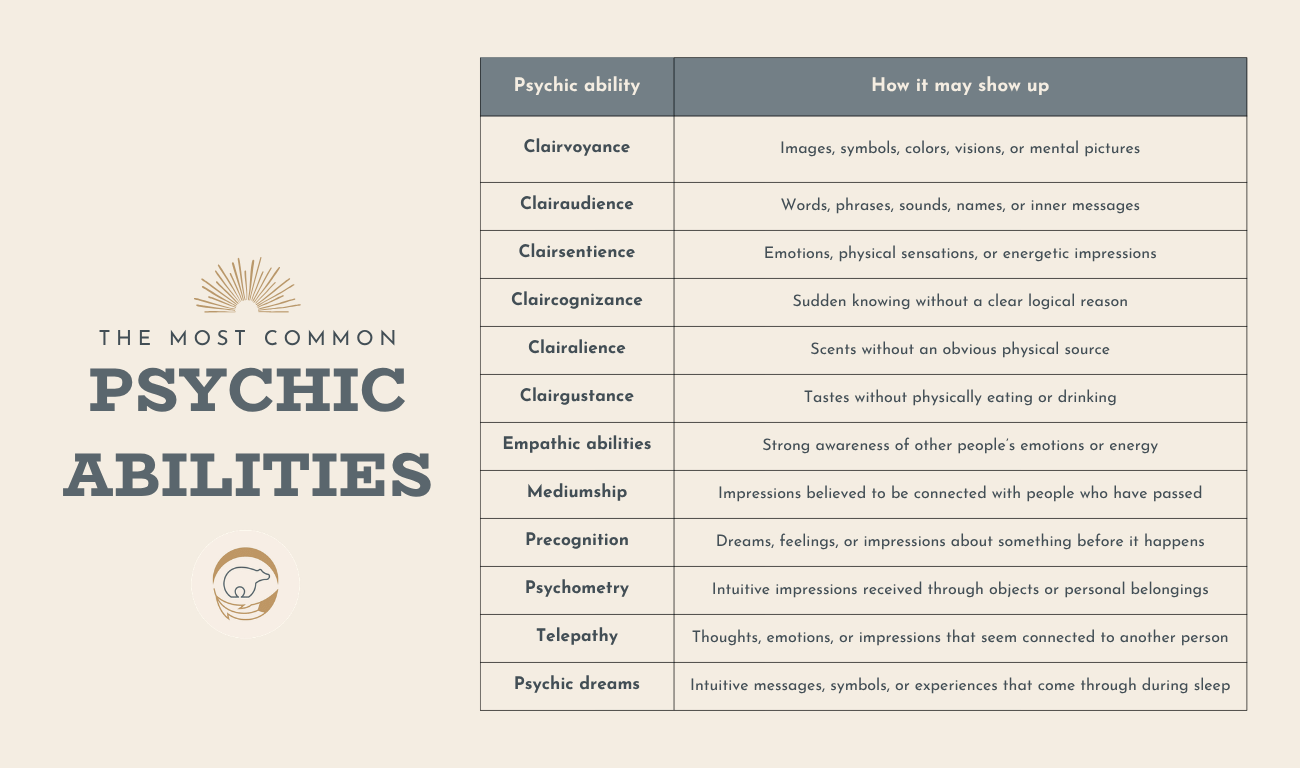
Clairvoyance - Clear Seeing
Clairvoyance describes receiving intuitive information visually, usually through images, symbols, colors, scenes, or flashes that appear in your mind.
This doesn’t necessarily mean seeing something physically in front of you. Clairvoyance can be much quieter than that. An image may suddenly pop into your mind during a conversation, you might repeatedly see the same symbol in your imagination, or a scene may appear when you’re thinking about a person or situation.
Examples of clairvoyance can include:
- seeing an image or symbol in your mind without intentionally imagining it
- receiving visual impressions while meditating or relaxing
- having vivid dreams that seem to carry a message
- picturing a person, place, or situation moments before it becomes relevant
- noticing colors, shapes, or imagery connected with certain people or energies
If intuitive information tends to arrive visually for you, clairvoyance may be one of the ways your intuition naturally communicates.
Clairaudience - Clear Hearing
Clairaudience refers to receiving intuitive information through words, sounds, phrases, names, or messages that seem to arise internally.
For many people, clairaudience doesn’t feel like hearing an external voice. It can be more like a thought that arrives with unusual clarity or a phrase that suddenly comes into your awareness without you consciously creating it.
Examples of clairaudience can include:
- a specific word or phrase suddenly appearing in your mind
- hearing someone’s name internally just before they contact you
- receiving an answer to a question as a clear inner message
- waking with a particular sentence, song, or phrase in your mind
- repeatedly noticing the same words or messages when you’ve been looking for guidance
The difference can be subtle, especially when clairaudience sounds similar to your own inner voice. Over time, you may begin to recognize when a message feels different from your usual stream of thoughts.
Clairsentience - Clear Feeling
Clairsentience is the ability to receive intuitive information through emotions, physical sensations, or an energetic sense of what is happening around you.
Someone with strong clairsentience may walk into a room and immediately sense that something feels tense, even though everyone appears perfectly calm. You may also experience physical sensations that seem connected to a person, place, or situation.
Examples of clairsentience can include:
- sensing the mood of a room before anyone speaks
- feeling unexpectedly comfortable or uneasy around a person or place
- experiencing chills, warmth, pressure, or tingling during an intuitive moment
- feeling another person’s emotions very strongly
- noticing a physical reaction when something feels aligned (or when it doesn’t)
Because this ability works through feelings, clairsentience can sometimes be confused with your own emotions. Learning to notice what you were feeling before entering a situation can help you begin to distinguish between the two.
Claircognizance - Clear Knowing
Claircognizance means “clear knowing.” Rather than seeing, hearing, or physically sensing intuitive information, you simply know something - often without any logical explanation for how you know it.
This can be one of the easiest psychic abilities to dismiss because it often feels like an ordinary thought. The difference is that the information tends to arrive suddenly and fully formed rather than through a process of reasoning.
Examples of claircognizance can include:
- knowing who is calling before looking at your phone
- suddenly knowing the answer to a question you’ve been thinking about
- having a strong certainty about which direction or decision feels right
- knowing something about a person without being told
- feeling certain that something is about to happen without knowing why
If you often find yourself saying, “I don’t know how I knew, I just knew,” claircognizance may be one of your strongest intuitive abilities.
Clairalience - Clear Smelling
Clairalience describes receiving intuitive information through scent, often when there is no obvious physical source for what you’re smelling.
A particular scent may appear suddenly and feel connected to a person, memory, place, or message. Because smell is so closely tied to memory and emotion, these experiences can feel especially personal.
Examples of clairalience can include:
- smelling a familiar perfume when the person who wore it isn’t nearby
- suddenly noticing the scent of flowers, smoke, food, or another distinct aroma with no clear source
- experiencing a particular scent while thinking about someone who has passed
- associating certain smells with intuitive messages or energetic shifts
- noticing the same unexplained scent repeatedly during meaningful moments
Like many psychic abilities, clairalience can be subtle and may initially feel like coincidence.
Clairgustance - Clear Tasting
Clairgustance refers to experiencing a taste without physically eating or drinking anything that would explain it.
This is one of the less commonly discussed types of psychic abilities, but for some people, taste can become another way intuitive information comes through.
Examples of clairgustance can include:
- suddenly tasting a particular food when you haven’t eaten it
- experiencing a taste while thinking about a specific person or memory
- noticing an unexplained taste during meditation or intuitive work
- connecting certain tastes with particular people, places, or impressions
Clairgustance may appear alongside other intuitive senses rather than on its own.
Empathic Abilities - Sensing the Emotions of Others
An empath is someone who feels especially sensitive to the emotions, moods, or energy of other people. This can overlap with clairsentience, but empathic sensitivity is often experienced specifically through emotional connection.
You may know that someone is upset before they say anything, feel your own mood shift when another person enters the room, or find that certain environments affect you more strongly than they seem to affect others.
Examples of empathic abilities can include:
- sensing someone’s emotional state without them telling you
- feeling drained or energized after spending time with certain people
- noticing your mood suddenly change around another person
- feeling emotional or physical discomfort in crowded environments
- having difficulty distinguishing your own emotions from what someone else may be feeling
Being highly empathetic doesn’t automatically mean every feeling is intuitive. But if you regularly pick up on emotional shifts before there are obvious external signs, empathic sensitivity may be an important part of your intuitive language.
Mediumship - Connecting With Spirit
Mediumship generally refers to receiving information or impressions believed to come from people who have died or from the spirit realm.
Mediumship isn’t necessarily a completely separate psychic sense. A medium may receive information through clairvoyance, clairaudience, clairsentience, or claircognizance. For example, one person might see an image connected to someone who has passed, while another may receive a name, feeling, memory, or sudden knowing.
Examples of mediumship experiences can include:
- sensing the presence of someone who has passed
- receiving an unexpected image, name, phrase, or memory connected to that person
- noticing meaningful scents, sounds, or sensations associated with them
- receiving information that feels distinct from your own thoughts or memories
- experiencing vivid dreams involving someone who has died
Not everyone who experiences intuitive abilities identifies as a medium, and having one of the clair senses doesn’t necessarily mean mediumship will be part of your experience.
Precognition - Sensing Something Before It Happens
Precognition describes receiving an impression about a future event before it occurs.
These impressions can come through dreams, feelings, mental images, sudden thoughts, or a strong sense that something is about to happen. Sometimes the meaning is immediately clear. Other times, the connection only becomes obvious afterward.
Examples of precognition can include:
- dreaming about an event before something similar happens
- thinking about someone shortly before they unexpectedly contact you
- having a strong feeling that plans are going to change before they do
- seeing a mental image of a situation that later takes place
- experiencing an unexplained sense of anticipation before an event
It’s worth remembering that not every prediction, dream, or feeling will turn out to be precognitive. These experiences are often easier to recognize as a pattern over time rather than through one isolated moment.
Psychometry - Receiving Impressions Through Objects
Psychometry is the ability to receive intuitive information by touching or holding an object.
Someone experiencing psychometry may pick up emotions, images, memories, physical sensations, or other impressions that seem connected with the object or its owner. Jewelry, photographs, clothing, and personal belongings are commonly associated with this type of experience.
Examples of psychometry can include:
- holding an object and suddenly feeling a strong emotion
- seeing an image or scene connected with the object
- getting an unexpected impression of its owner
- sensing whether an object feels comforting, heavy, peaceful, or unsettling
- receiving information about where an object has been or what it may be connected to
Psychometry can involve several psychic senses at once, depending on how the information comes through.
Telepathy - Receiving Thoughts or Impressions From Others
Telepathy is usually described as the experience of receiving thoughts, feelings, images, or impressions that seem to come from another person without ordinary communication.
People often describe these moments with someone they are particularly close to — thinking the same thing at the same moment, knowing what the other person is about to say, or suddenly feeling that they need to reach out.
Examples of telepathic experiences can include:
- thinking of someone just before they call or message you
- knowing what someone is about to say
- having the same unusual thought as another person at the same time
- suddenly feeling an emotion that seems connected to someone close to you
- receiving an image or impression that another person later confirms
Some of these experiences can, of course, also have ordinary explanations. What tends to make them feel significant is when the same type of connection happens repeatedly.
Psychic Dreams - When Intuition Comes Through Sleep
Dreams can be another way intuitive information seems to surface. Psychic or intuitive dreams are often described as unusually vivid, emotionally powerful, or somehow different from an ordinary dream.
Some may feel symbolic, while others appear remarkably literal. You might wake up knowing that a dream felt important even when you don’t yet understand why.
Examples of psychic dreams can include:
- dreaming about something that later happens
- receiving a clear message or answer in a dream
- dreaming repeatedly about the same symbol, person, or situation
- having an unusually vivid dream involving someone who has passed
- waking with a strong feeling that the dream contained information you need to remember
Dreams can contain a mix of memory, emotion, imagination, and intuition, so not every vivid dream needs to have a deeper meaning. Often, the most useful thing is simply to notice which dreams stay with you and whether certain patterns begin to repeat.
Understanding Your Own Psychic Abilities
There’s no single right way for psychic ability to show up. You may receive information through images, feelings, dreams, words, or simply a sense of knowing - and more than one type can be present at the same time.
The most helpful thing is to notice the patterns that repeat for you. The more familiar you become with your own intuitive language, the easier it can be to recognize when something feels meaningful rather than random.
You don’t need to force a label onto your experience. Let the different types of psychic abilities give you a framework, then pay attention to what actually feels true for you.


