


Share


Have you ever felt something so clearly… and yet struggled to explain it?
Maybe it showed up as a quiet pull, a sense of knowing that didn’t come with words. And then later - sometimes hours, sometimes days after - everything suddenly made sense.
It’s easy to assume those moments are the same thing. That intuition and insight are interchangeable, just different words for inner guidance.
But they don’t move the same way.
One arrives before you understand. The other helps you make sense of what you’ve already felt.
And the more you begin to notice the difference, the less you’ll find yourself questioning what’s true for you.
What Is Intuition? (Knowing Without a Story)
Intuition is often the first thing that speaks - even if you don’t recognize it right away.
It doesn’t come with explanations or fully formed thoughts. It shows up as a feeling, a pull, or a quiet sense that something is right - or isn’t. And most of the time, it arrives before your mind has had any chance to process what’s happening.
You might notice it in small moments. The instant sense you get about a person you’ve just met. The feeling that something isn’t aligned, even when everything looks fine on the surface. Or the quiet nudge toward something you can’t logically justify yet.
It can be easy to dismiss these moments because they don’t always make sense. They don’t follow a clear line of reasoning, and they rarely explain themselves.
But that doesn’t mean they’re random.
In many ways, intuition is your system recognizing patterns faster than your conscious mind can keep up with. It draws from everything you’ve experienced, felt, and absorbed - and distills it into something immediate and simple.
That’s why it often feels so subtle.
It doesn’t push or argue. It doesn’t repeat itself endlessly. It just appears, and then it’s gone.
And the more you try to force it into words too quickly, the easier it is to lose what it was trying to show you in the first place.
What Is Insight? (The “Aha” That Arrives Later)
If intuition is the quiet knowing that comes first, insight is the moment when everything finally makes sense.
It doesn’t always come when you’re actively searching for answers. In fact, it often appears when you’ve stopped trying to figure things out. You step away, shift your focus, or simply let the question sit… and then, suddenly, something clicks.
A new perspective forms. A pattern becomes clear. What once felt confusing now feels obvious.
That’s insight.
It doesn’t feel like effort or analysis. It feels like a shift - as if something rearranged itself internally, and you’re now seeing the same situation through a completely different lens.
Interestingly, even research into how the brain solves problems points to this same experience. Insight tends to emerge suddenly, after a period of not knowing, as if something has been quietly working beneath the surface all along.
In other words, your mind doesn’t always process things in a straight line.
Sometimes it gathers pieces in the background - without your awareness - until they naturally come together in a way you can finally understand.
That’s why insight can feel so satisfying.
It brings language to something that was previously just a feeling. It creates clarity where there was uncertainty. And it allows you to make sense of what you may have already sensed, even if you couldn’t explain it at the time.
You could think of it this way:
Intuition speaks first. Insight helps you understand what it said.
Intuition vs Insight
Intuition and insight often feel like they belong to the same experience. And in many ways, they do.
But they don’t arrive in the same way - or at the same moment.
Intuition tends to come first. It’s immediate, subtle, and often hard to explain. It doesn’t wait for logic or understanding. It simply appears, as a feeling or a quiet sense of knowing.
Insight comes later. It’s the moment when something clicks into place. When you can finally see the pattern, understand the situation, or put words to something that once felt unclear.
They’re not separate abilities.
They’re two parts of the same process - one that begins with feeling and unfolds into understanding.
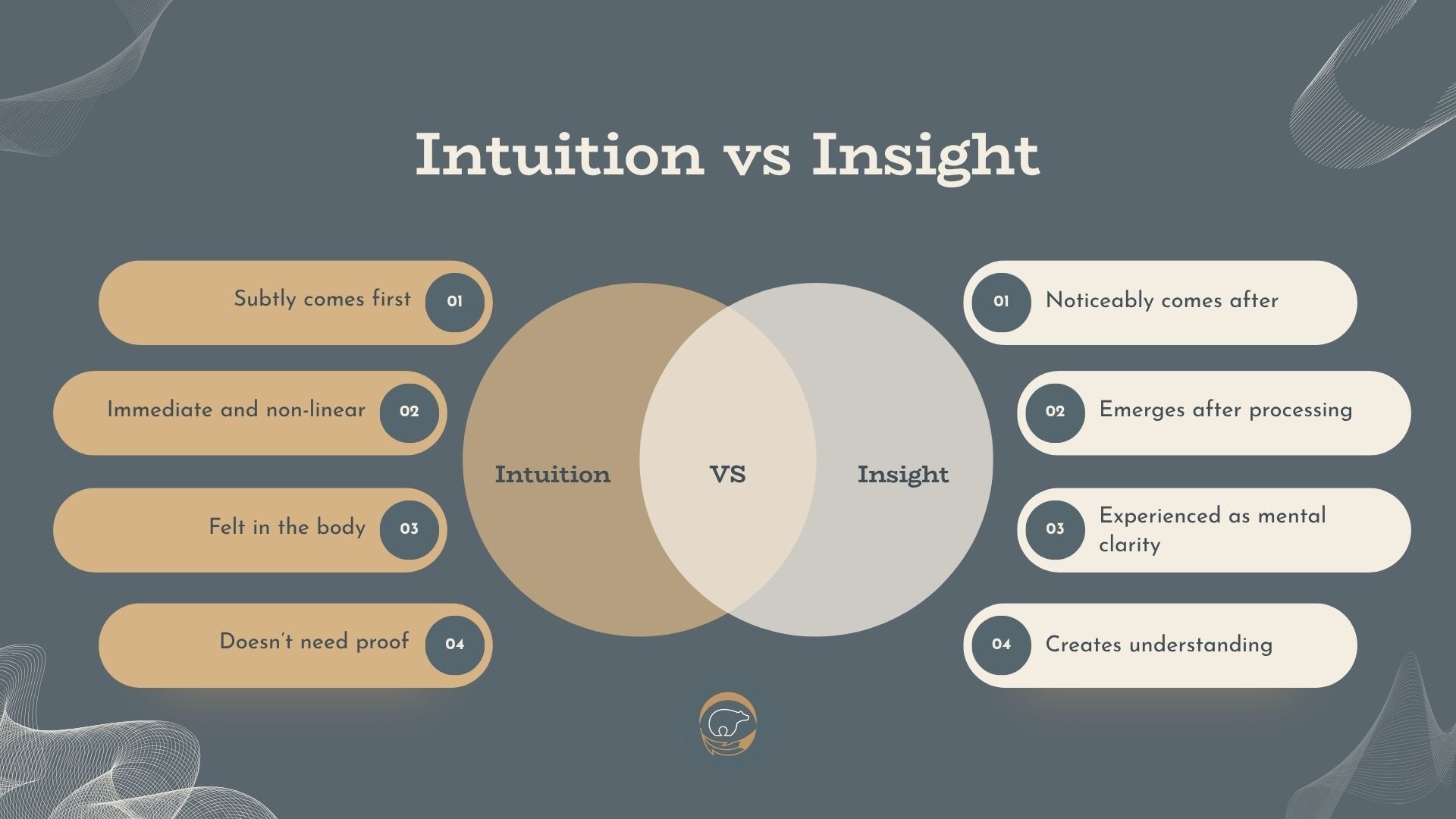
If you’ve ever had a moment where something didn’t feel right… but you couldn’t explain why until later - you’ve experienced both.
First, there was the feeling. Then, there was the understanding.
Intuition told you something mattered. Insight helped you understand what it meant.
How They Work Together
Rather than choosing between intuition and insight, it can be more helpful to see how they naturally support each other.
Intuition often guides you toward an experience, a decision, or a moment that holds something important. Insight is what allows you to integrate it.
You feel first. You understand later.
And the more you begin to trust that sequence, the less pressure there is to figure everything out immediately.
Why Intuition Is So Easy to Confuse with Overthinking
For many people, the challenge isn’t accessing intuition - it’s learning to distinguish it from everything else happening in the mind.
Because the moment a feeling arises, the mind often tries to make sense of it.
It starts asking questions, looking for explanations, replaying scenarios, and trying to arrive at a clear answer. What began as a simple, quiet signal can quickly turn into something much louder and more complicated.
And over time, this creates confusion.
What was once a subtle sense of knowing becomes layered with thoughts, doubts, and what-ifs, until it’s difficult to tell what came first.
Intuition itself is usually simple. It doesn’t come with a long internal dialogue or a need to justify itself. It tends to feel steady, even when it’s pointing you toward something uncertain.
Overthinking feels very different.
It pulls you into loops. It creates urgency. It tries to resolve everything at once, often leaving you feeling more unsettled than before.
Part of why this happens is that the mind is trying to do something it isn’t always designed for - to force clarity before it’s ready.
Interestingly, even research into insight shows that real clarity doesn’t usually come from pushing harder or thinking more. It tends to emerge after a period of mental stepping back, when the brain has had space to process things in the background.
Which means the more pressure you put on yourself to “figure it out,” the further you can move from the clarity you’re actually looking for.
This is why intuition can feel like it disappears.
It’s not that it’s gone - it’s just being talked over.
And this is also why insight often arrives later, in quieter moments, when the mind finally softens enough for something deeper to come through.
Learning to Trust What You Feel - and What Follows
You’re not meant to have immediate clarity about everything you sense.
Some things arrive as a feeling first. A quiet awareness that doesn’t ask to be explained right away. And only later, sometimes much later, does the understanding begin to unfold.
This is the natural rhythm between intuition and insight.
One shows you something before you’re ready to define it. The other helps you make sense of it when the time is right.
When you begin to recognize this, the pressure to “figure everything out” starts to soften. You don’t have to translate every feeling in the moment. You don’t have to force clarity before it’s ready to arrive.
You can allow yourself to notice what’s there… and trust that understanding will follow.
Over time, this creates a different kind of relationship with yourself. One that isn’t built on constant questioning, but on a quieter sense of trust in how your inner world communicates.
And if you’ve ever felt like your intuition is there but just out of reach, or difficult to fully understand, sometimes it helps to have a space that gently brings language to those experiences.
If you want to explore this more deeply, read the The Language of Intuition eBook - a soft, grounded guide to awakening your intuitive intelligence and learning to trust yourself from the inside out.
Because the more familiar this inner language becomes, the less you’ll find yourself doubting what you already feel.


