


Share


As souls, we’re naturally drawn toward connection. There’s an inner recognition that happens when we meet certain people, a quiet knowing that this connection matters beyond circumstance or logic.
Your soul seeks these encounters instinctively, not for comfort alone, but for the experience of love, reflection, and growth.
Sometimes the idea of a soul family doesn’t arrive as a concept, it arrives as a feeling.
It shows up when you meet someone and feel an immediate sense of familiarity, even if you can’t explain why. Certain connections seem to bypass logic, moving faster or deeper than expected.
In this article, we’ll explore what a soul family is, how it differs from a soul tribe, and the signs that often point to these kinds of connections. We’ll also look at common questions around how many souls belong to a soul family and how these relationships tend to find us, often when we’re not searching at all.
This isn’t about labels or rigid spiritual definitions. It’s an invitation to understand the deeper patterns behind meaningful relationships and to trust the subtle recognition that already lives within you.
What Is a Soul Family?
A soul family is less something you define and more something you recognize.
It’s the group of souls you feel a deep, familiar resonance with, even if the relationship itself is new or doesn’t fit neatly into your life. These connections often carry a sense of remembering, as though something within you already knows this person matters, before your mind can explain why.
Soul family relationships aren’t always easy or harmonious. Some feel supportive and nourishing, while others arrive to challenge you, reflect old patterns, or invite growth in uncomfortable ways. What they tend to share is impact. They move you. They change you. They ask something of you.
Not everyone in your soul family is meant to stay forever. Some walk beside you for years, others appear briefly and leave a lasting imprint. The connection isn’t defined by duration or role, but by what it awakens within you.
At their heart, soul family connections invite you into deeper awareness. They help you see yourself more clearly, sometimes through love and recognition, and sometimes through contrast. In that way, they’re less about belonging to a group and more about remembering who you are.
Within this wider field of connection, some soul family connections are experienced as soulmates – deeply personal relationships that shape how we understand intimacy and love. These connections have their own rhythm and purpose, distinct from the wider soul family network.
Soul Family vs Soul Tribe: What’s the Difference?
The terms soul family and soul tribe are often used interchangeably, but they point to slightly different kinds of connection.
A soul family tends to reflect deeper, long-standing energetic bonds. These are the connections that feel familiar on a soul level, even when the relationship itself is complex or challenging. Soul family members often return in different roles across lifetimes and carry recurring themes that invite healing, growth, or remembering. These relationships can feel intense, transformative, and sometimes difficult to move away from.
A soul tribe, on the other hand, is usually felt through resonance in the present moment. Your soul tribe is made up of people who align with your current values, frequency, and way of seeing the world. These connections often feel supportive, affirming, and expansive, and they may shift as you evolve. As you change, your soul tribe can change with you.
You can belong to more than one soul tribe in a lifetime, and not everyone in your soul tribe is part of your soul family. Some connections are here to walk with you now, while others are here to help you remember something much older.
Neither is more important than the other. Both serve different purposes, and both can play meaningful roles in your life.
Soul Family Signs
Soul family connections are rarely announced clearly or logically. They tend to be felt first, registered quietly in the body or the heart before the mind tries to make sense of them.
Rather than following a single rule or definition, these connections often reveal themselves through patterns of recognition, depth, and impact.
While every experience is unique, there are some common signs that many people notice when they encounter a soul family connection.
These aren’t meant to be a checklist or a test, but gentle markers that can help you reflect on the relationships that have shaped you most.
- A strong sense of familiarity, even when you’ve just met
- Feeling emotionally or energetically seen without needing to explain yourself
- Conversations that naturally move into depth, meaning, or vulnerability
- A connection that feels activating rather than simply comfortable
- Being mirrored in ways that highlight both your growth and your patterns
- Relationships that trigger inner shifts, realizations, or healing
- A sense that the timing of the meeting was significant or meaningful
- Intensity that doesn’t always feel easy, but feels purposeful
- A lasting impact, even if the connection itself is brief
- A quiet inner knowing that this person matters in your life story
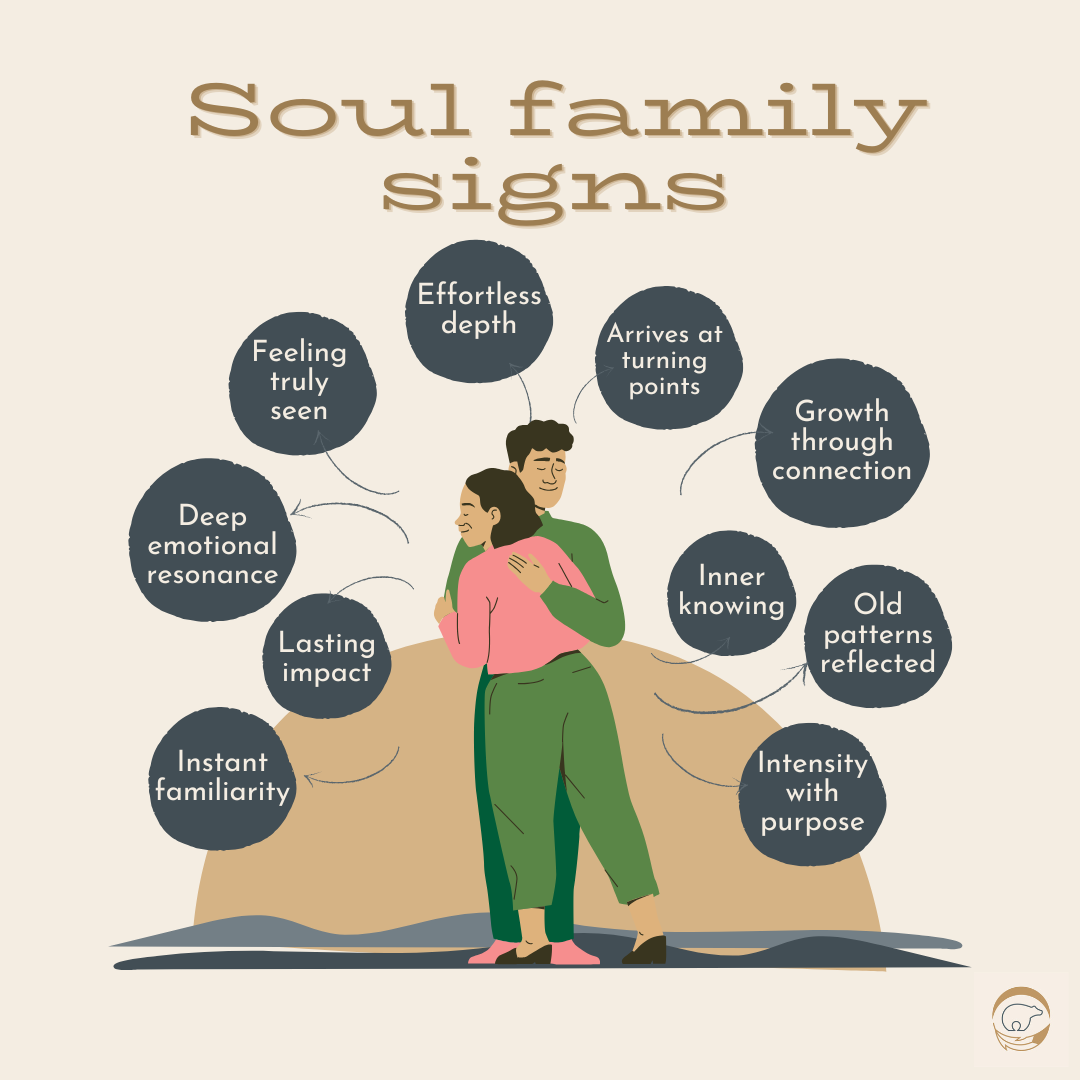
Not every soul family connection will include all of these signs, and their presence doesn’t guarantee that the relationship will be easy or permanent.
What matters most is the way the connection influences your awareness, growth, and sense of self. Often, soul family relationships are less about staying and more about what they awaken within you.
How Many Souls Are in a Soul Family?
There isn’t one agreed-upon answer to how many souls belong to a soul family, and that’s intentional.
In many spiritual frameworks, a soul family is described as having a core group of souls, sometimes referred to as an original soul family. This core is often said to include anywhere from a handful to a few dozen souls who share a similar energetic origin and return into one another’s lives across different lifetimes and roles. These are the connections that tend to feel especially familiar, layered, or emotionally significant.
Beyond this core, most teachings describe the soul family as an evolving network rather than a fixed group. Other souls may come in as part of shared missions, life themes, or periods of growth. These connections might feel just as meaningful, even if they’re present for a shorter time or serve a very specific purpose.
What matters more than numbers is timing. Not every soul in your soul family appears in every lifetime, and you’re not meant to meet everyone at once. Certain connections activate when you’re ready for the lesson, reflection, or expansion they carry. Others remain dormant until a different stage of your journey.
Rather than thinking of soul family as a list you need to complete, it’s often more helpful to see it as a living system. The right souls tend to find you when their presence supports who you’re becoming, not when you’re searching for them.
How to Find Your Soul Family
Rather than doing more or trying harder, soul family connections often unfold when you’re living in quiet alignment with yourself. A few orientations that tend to support these connections include:
- Living from what feels true to you. When you stop shaping yourself to fit expectations and allow your natural strengths and sensitivities to lead, the right connections tend to respond to that honesty.
- Spending time where your energy naturally wants to go. The spaces, conversations, and causes that genuinely light you up often carry the same frequency as the people you’re meant to meet.
- Letting connections arrive in unexpected forms. Soul family doesn’t always look like instant closeness. It can show up as a teacher, a collaborator, or someone you meet later in life, often after you’ve changed.
- Paying attention to where depth feels easy. Some connections invite real presence without effort, where conversation moves beyond the surface and mutual understanding feels natural.
Soul family relationships aren’t something to pursue or prove. They tend to emerge when there’s mutual readiness, often without announcement. Trust that the connections meant for you will find you when they support your next stage of growth.
You’re Not Missing Anyone
If you’re reading this and feeling the absence of certain connections, it’s important to know that you’re not behind, disconnected, or doing anything wrong.
Soul family relationships don’t arrive on a fixed timeline, and they aren’t something you earn by doing life “right.” They unfold in rhythm with your inner alignment.
Some connections appear early and stay. Others arrive later, or only briefly, leaving a quiet but lasting shift. Often, the first and most important soul family relationship is the one you build with yourself. As you come into deeper honesty and presence with who you are, recognition becomes easier, both inwardly and outwardly.
Rather than searching for specific people, this journey asks for trust. Trust in timing. Trust in resonance. Trust that what’s meant to meet you will do so when it supports who you’re becoming.
If questions around soul family, belonging, and connection are alive for you, Awakening the New Human offers a deeper exploration of these themes. The book expands the idea of family beyond biology, helping you understand both soul family and lineage as part of the same awakening process.
It’s written for those who feel the pull toward deeper connection and want grounded guidance on how consciousness, relationship, and self-awareness evolve together.


