


Share


We often hear the phrase low vibration emotions, but what does it truly mean in a lived, human way?
These emotions are the feelings that tend to feel heavy in the body and gray in the mind. Sadness, doubt, discouragement, resentment, fear, and emotional fatigue are often labeled as “low vibration,” yet none of these states are mistakes or signs that you’re doing something wrong.
These feelings can simply be signals that something within you is asking for care, attention, or time. They appear when life feels overwhelming, when inner growth is happening faster than the mind can understand, or when old patterns are slowly loosening.
Low vibration emotions are not evidence of spiritual regression. They are part of the natural rhythm of being alive.
So rather than asking, “How do I get rid of this?” we might begin asking, “What is this emotion trying to show me?”
That question opens a door, not to fixing or forcing, but to understanding.
Let’s begin by exploring what low vibration emotions actually are, and why they show up during certain seasons of our lives.
What Are Low Vibration Emotions
When we talk about low vibration emotions, we’re referring to emotional states that feel heavier, slower, or more contracted in the body and mind. These emotions often happen when we feel overwhelmed, unsafe, stretched beyond our capacity, or when we’re moving through a season of transition or integration.
They are not wrong. They don’t mean you are off your path. They often mean you are in the middle of learning something important.
Common low vibration emotions include:
- Shame
- Guilt
- Fear
- Grief
- Apathy / numbness
- Discouragement
- Worry
- Anger or irritation
- Hopelessness
- Self-doubt
These emotions tend to pull your energy inward, asking you to slow down and be with yourself. They are messages, not failures.
The Emotional Spectrum
Instead of thinking of emotions as “positive” or “negative,” it can help to think of them in terms of expansion and contraction.
Some emotions feel expansive - they open the chest, soften the breath, and create a sense of connection.
Others feel contracted - they draw us inward, slow us down, or make us feel tight and closed.
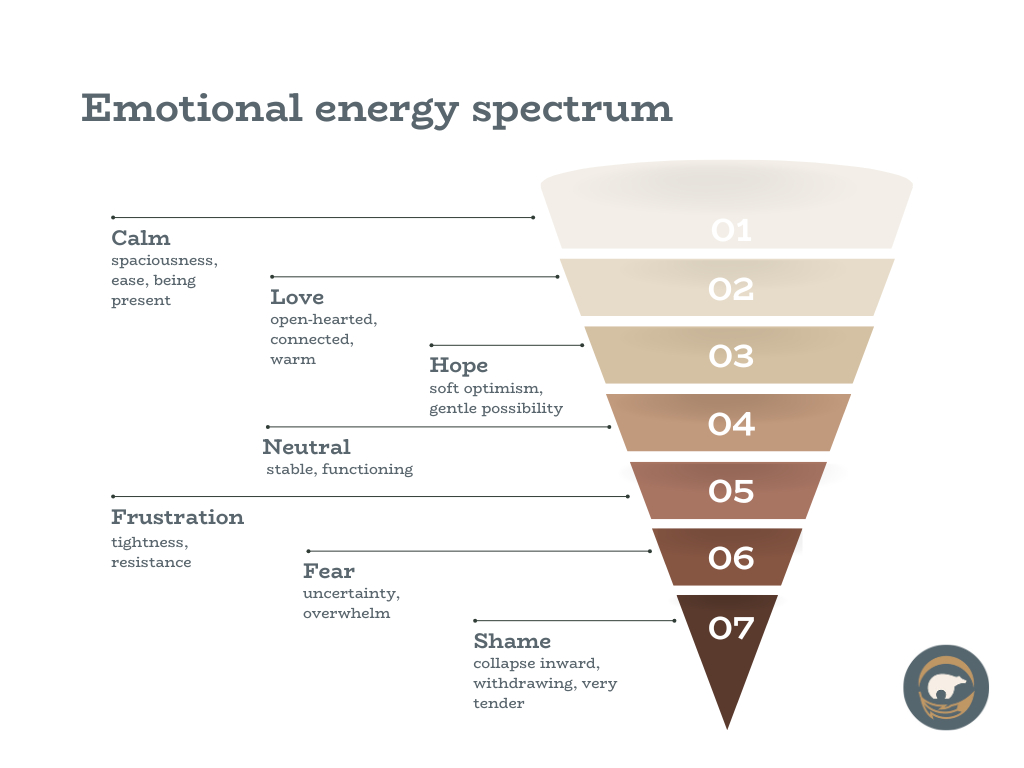
When you look at this spectrum, it’s not about choosing a state to be in or trying to move yourself upward. It’s simply a way of understanding how emotions shift inside you. Some days feel spacious and clear. Other days feel heavy, tender, or uncertain. Most of us move through many places on this spectrum in the course of a single day. There is nothing wrong with that movement. It’s part of how the heart learns and how the nervous system responds to life.
The invitation isn’t to judge where you are, but to notice it. To feel the difference between the moments when your chest softens and you breathe easily, and the moments when your body pulls inward and asks for quiet.
This is how we begin to work with emotions not as problems to solve, but as experiences that carry meaning. We meet ourselves where we are.
Why Low Vibration Emotions Matter
Low vibration emotions often show up when we are moving through something important. They arise in moments of change, loss, transition, or inner growth - times when the heart is stretching into a new understanding of itself. These emotions can feel heavy or uncomfortable, but that heaviness is often the weight of something meaningful being processed inside of you.
When you feel frustration, fear, grief, or shame, your system is not failing. It is responding.
It is trying to protect you, to slow you down, or to draw your attention toward something that needs tenderness. These emotional states are part of how the body and the spirit communicate. They are invitations to pause, to breathe, and to listen more deeply.
And although the mind may want to fix or solve the feeling, the deeper work happens when we allow ourselves to be with it. When we soften around the emotion instead of resisting it. When we let it move in its own rhythm rather than forcing it to resolve.
Low vibration emotions are not asking you to rise above them. They are asking you to meet yourself.
They are the places where self-compassion is needed most. The beginning of understanding often starts here - quietly, in the honesty of what you feel.
What Low Vibration Emotions Are Asking For
Low vibration emotions often appear when a part of you feels unsafe, unseen, or overwhelmed. They can show up when you’ve been carrying too much for too long, or when an old wound is being touched by something happening in the present moment.
They are teachers, signals, part of the journey that invite reflection, grounding, and inner repair:
- Frustration may be asking for boundaries.
- Fear may be asking for reassurance or clarity.
- Grief may be asking for time and tenderness.
- Shame may be asking to be met, not hidden.
When we learn to listen to what the emotion is needing rather than judging the emotion itself, something shifts. The feeling becomes less sharp. The body loosens. The mind stops spiraling. And the heart begins to find its own way forward.
You don’t have to force your way out of a low vibration emotion. You only need to turn toward it instead of away.
If this feels familiar, or if fear tends to be the emotion that pulls you inward the most, you may find the From Fear to Freedom course helpful. It’s designed to support the process of meeting these tender emotional states with compassion and presence instead of pressure or avoidance.
It teaches you how to sit with yourself inside the moment where the heart wants to collapse and stay open just enough to soften.
Your Emotions Are a Journey
There will be days when your emotions feel light and spacious, and days when they feel heavy or uncertain.
Both belong. Both are part of being alive.
Low vibration emotions are not evidence that you’re moving backwards. They often show up when something important is shifting inside you, when you’re growing in ways your mind hasn’t fully understood yet.
If you can meet yourself gently in these moments instead of rushing to feel better or be better, you’ll begin to notice that even the heavier emotions have texture, meaning, and movement. They shift when they feel seen.
They open when they’re met. And over time, they become part of your understanding of yourself - a deeper, kinder, more spacious one.


