


Share


“Trust your intuition” sounds simple. But for many of us, the difficult part is not whether we want to trust ourselves. It is knowing which part of ourselves we are listening to.
Anxiety can feel like a warning. Intuition can bring a truth that immediately stirs fear. Both can appear as a sensation in the body, a thought that seems to come from nowhere or a sense that something is not quite right. In the moment, they can be difficult to separate.
I do not believe the answer is to label one voice as good and the other as bad.
Anxiety is usually trying to protect you. Intuition may be trying to show you something you are not yet comfortable seeing. The two can be present at the same time.
Discernment begins when you slow the experience down enough to notice its layers.
What came first? What did fear add? And what still feels true once the urgency settles? This is where we can begin to understand the difference - not through a perfect formula, but by becoming more familiar with our own inner guidance.
Why intuition and anxiety can feel so similar
You meet someone and something feels off, even though you cannot point to anything they have said or done. Or you are about to make a change you know you want, but your body tightens and your mind tells you to step back.
In both moments, the feeling seems to be giving you important information. The difficult part is understanding where that information is coming from.
Intuition and anxiety can be hard to separate because they often reach us in similar ways.
Either one may appear as a physical sensation, a sudden thought or a shift that your conscious mind cannot yet explain. You notice that something has changed within you, and then the mind begins searching for a reason.
Perhaps you are picking up on something subtle - a change in someone’s tone, an inconsistency you have not consciously noticed or a choice that does not feel aligned with who you are. But it is also possible that the present moment has touched an older fear, and part of you is responding to what happened before rather than only to what is happening now.
This does not mean the feeling is imagined. It means there may be more than one layer to understand.
Sometimes intuition is the first layer and anxiety arrives afterwards. You may realize that a relationship, job or situation is no longer right for you, then immediately become afraid of what that truth could change. The fear does not necessarily make the original knowing untrue. It may simply be your mind trying to protect you from the uncertainty that comes with listening to it.
Rather than asking one feeling to prove what it is, begin by noticing the sequence.
What appeared first? What came next? And when the thoughts began to multiply, were they offering new information or trying to create certainty?
These small distinctions can help you hear what each part of you is actually saying.
The difference is not always in the volume
One of the most repeated ideas about intuition and anxiety is that intuition whispers while anxiety shouts. This can be a helpful place to begin, but it is not a rule.
Anxiety does not always feel dramatic. Sometimes it sounds measured and reasonable: Maybe I should wait until I am completely certain. Perhaps I should check one more time. I just need to think through every possible outcome. It can keep you circling the same decision while convincing you that you are being careful.
Intuition is not always gentle, either. It may feel strong when you sense genuine danger, need to set a boundary or understand a truth that could change your life. The intensity of the response does not necessarily tell you where it came from.
A more helpful clue is what happens after the feeling appears.
Intuition often gives you something relatively simple: I need more time. This does not feel right. Reach out. Take the opportunity. It may not explain itself immediately, but it usually does not need to build an endless argument.
Anxiety tends to add layers. One concern leads to another, then another. It wants to predict every possible outcome and find the one decision that guarantees you will not be hurt, embarrassed or disappointed.
You may first sense, Do not say yes yet. Then the mind responds: What if I lose the opportunity? What if I disappoint someone? What if I never get another chance? The anxiety that follows does not automatically mean the first message was wrong. It simply means fear has now joined the conversation.
Instead of measuring how loud the feeling is, notice how it moves. Does it remain clear, or does it keep multiplying? Does it leave room for facts and reflection, or push you to remove uncertainty immediately? Does it point toward one grounded step, or demand that you solve the entire future?
These patterns often tell you more than whether the feeling arrived as a whisper or a shout.
What anxiety is trying to protect you from
Anxiety is often treated as something that blocks intuition - a voice we need to silence before we can hear ourselves clearly. But anxiety is rarely trying to mislead us. More often, it is trying to prevent pain.
It may be protecting you from rejection, disappointment, embarrassment or the possibility of making the wrong choice. Sometimes it is responding to something that is happening now. At other times, it is drawing on what you learned from an earlier experience: This happened before, so I need to make sure it never happens again.
That protection can look like analyzing every detail, replaying conversations or searching for signs that confirm whether you are safe. It may encourage you to avoid a decision altogether or keep asking for reassurance, hoping that one more answer will finally remove the uncertainty.
But most meaningful choices come with some uncertainty. No amount of thinking can promise that a relationship will never hurt, an opportunity will work out exactly as planned or an honest decision will be understood by everyone around you. When anxiety cannot find that guarantee, it often keeps searching.
This is why more analysis does not always bring more clarity. Sometimes you are not missing information. You are trying to reach a level of certainty that the situation cannot give you.
Rather than fighting the anxiety, it can help to recognize what it is trying to protect. Perhaps it is saying, I do not want you to be hurt again, or I am afraid you will regret this. Acknowledging that fear does not mean allowing it to make the decision. It simply helps you separate the need for protection from the guidance you are seeking.
Anxiety does not need to be shamed, but it also does not need the final say. You can listen to what it fears, care for the part of you that feels vulnerable and still leave room for another truth to emerge.
How to tell the difference between intuition and anxiety
When people ask how to tell the difference between intuition and anxiety, they are often hoping for one clear sign - a particular feeling in the body or a quality that will immediately identify which voice is speaking.
But discernment rarely works through one sensation alone. It becomes easier when you look at the wider pattern: how the message develops, where it directs your attention and what it asks you to do next.
Anxiety often tries to create safety by removing uncertainty. Intuition is more likely to draw your attention to something important without attempting to predict or control every consequence. One tends to keep expanding, while the other remains closer to its original message.
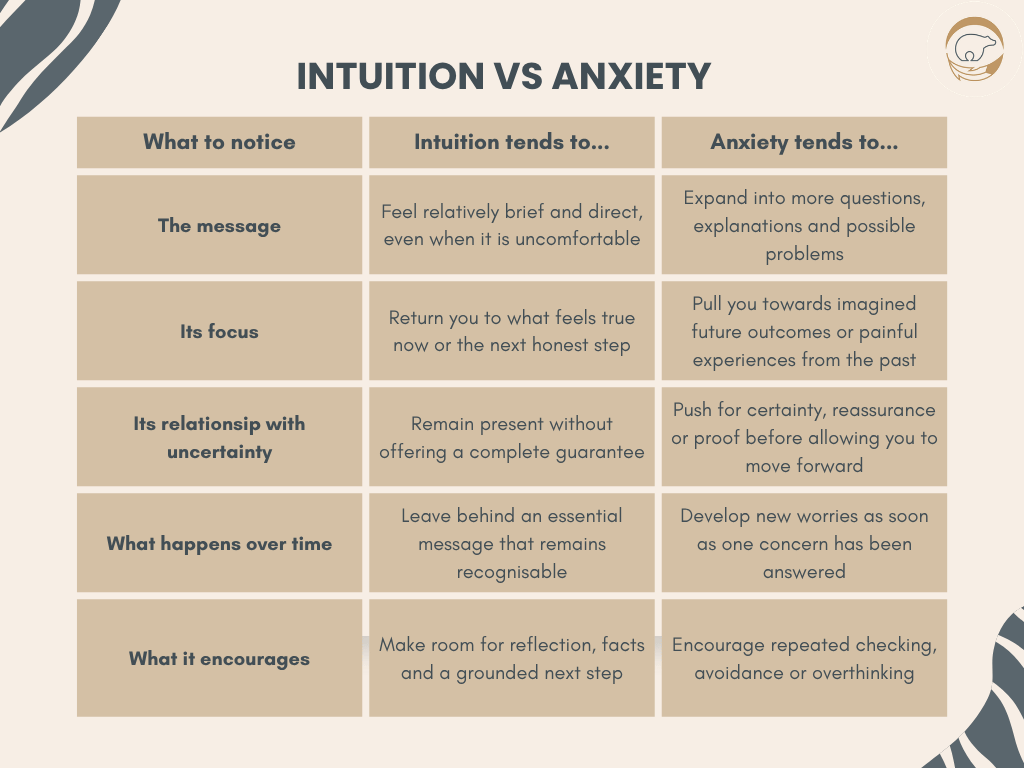
These are tendencies, not rigid rules. A short thought is not automatically intuition, just as a complicated feeling is not automatically anxiety.
This is also why physical sensations cannot provide the answer on their own. Both intuition and anxiety may appear as a tight chest, a change in energy, a knot in the stomach or a sudden urge to move toward or away from something. Your body is offering information, but that information still needs context.
Instead of asking only, Which voice am I hearing?, try asking: What is the simplest message here? What has fear added to it? And what do the facts show me?
You do not have to choose between trusting your inner guidance and thinking carefully. The two can work together.
What to do when you still cannot tell
There will be moments when you pause, listen and still do not know whether you are feeling intuition or anxiety. That does not mean you are disconnected from yourself. Sometimes both are present, and sometimes you simply do not have enough information yet.
When the answer is unclear, the goal is not to force certainty. It is to create enough space to hear more than the fear.
Give the feeling some room
If the decision does not need to be made immediately, step away from it for a little while. This is not about avoiding the choice. It is about allowing the first wave of urgency to pass so you can return with more perspective.
Return to the simplest message
Try to name what appeared before the explanations began. Perhaps it was I need more time, Something feels different or I want to do this. Then notice what the mind added afterwards. Separating the original message from the story around it can make the different layers easier to recognize.
Let the facts join the conversation
Ask yourself what you genuinely know, what you are assuming and whether there is more information you can gather. Trusting your intuition does not mean ignoring reality, and anxiety should not be dismissed simply because it feels uncomfortable. Your inner response, your values and the available facts can all be considered together.
Take one honest next step
You may not need to decide the entire future. You might ask a question, request more time, set a small boundary or speak with someone grounded who will help you reflect without making the choice for you. Sometimes clarity develops through the next step rather than through more thinking.
You do not need to feel completely calm before making a decision. You only need enough space to notice what fear is asking for, what your deeper sense is telling you and what the situation itself requires.
Over time, these patterns become more familiar. You begin to recognize how anxiety moves through you and how your intuition gets your attention. That recognition is where self-trust begins to grow.
Learning to trust yourself
The truth is, you probably will not be able to tell the difference perfectly every time. Sometimes you will realise later that anxiety was shaping the story more than you thought. Other times, you will look back and see that you knew what felt right from the beginning.
That is part of learning how intuition works for you.
The more you notice what comes first, what fear adds and what remains when you slow things down, the easier it becomes to recognize your own patterns. You do not need to get rid of anxiety before you can hear your intuition. You simply need enough space to stop the two from sounding like the same thing.
If this is something you would like to explore further, I go into it in much more detail in The Language of Intuition. It is a self-guided eBook designed to help you see and trust the ways intuition shows up in everyday life. You can move through it at your own pace and return to it whenever you need to reconnect with what you are hearing.


