


Share


We’ve all heard the terms: spiritual awakening, enlightenment, a shift in consciousness.
They sound beautiful, like the ultimate goal of the soul's journey. And yet, for many people, these words can also bring up discomfort or hesitation.
Why?
Because the very wording - "awakening" - implies a fundamental shifting of reality perception. It suggests that the stable, predictable world we've built our lives upon is a dream we're about to wake up from.
This article explores the fear of spiritual awakening from that place, as a natural response to change, and an invitation to understand what’s really being stirred beneath the surface.
Why the Fear of Spiritual Awakening Happens at All
Spiritual awakening is often described as an expansion of awareness, but what’s less talked about is how destabilizing expansion can feel at first.
When the way you perceive yourself or the world begins to change, even subtly, the nervous system has to adjust. For most of us, identity, beliefs, routines, and roles create a sense of stability. They help us orient ourselves in daily life.
When awareness starts to shift, those familiar reference points can loosen. Naturally, fear arises.
This fear isn’t usually about something dramatic happening. More often, it’s about the loss of certainty. Not knowing what this shift means, how far it will go, or what it might change can feel unsettling - especially if there’s no clear framework for understanding what’s happening.
If you look at the 7 stages of spiritual awakening, you’ll see that fear and confusion are not signs of failure; they are actually specific, expected phases of the journey.
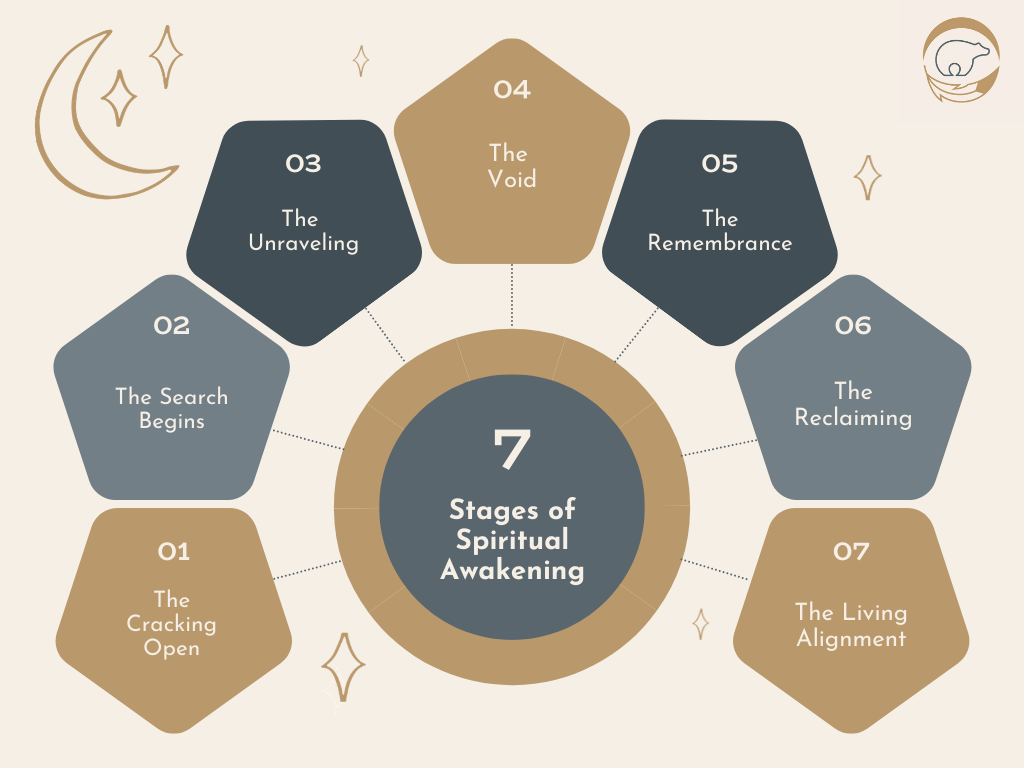
The fear is a signal that something meaningful is reorganizing, and that your system is looking for time, context, and grounding.
When Identity Starts to Shift: The Ego’s Response
As awareness begins to change, it’s often identity that feels it first. The roles you’ve inhabited, the stories you’ve told about who you are, and the ways you’ve learned to relate to the world can start to feel less fixed.
The ego, in this context, isn’t something negative. It’s the part of you that helps maintain continuity. Its primary role is stability.
When spiritual awakening begins to loosen old patterns of identity, the ego can interpret that shift as a threat. Not because something bad is happening, but because change itself challenges what has kept you oriented and safe.
This is where fear often enters. It may show up as:
- a concern about losing yourself
- a fear that you are changing too much
- a panic that you don't recognize who you are anymore
Rather than seeing this as something to overcome, it can help to understand it as a protective response. The ego isn’t trying to stop awakening; it’s trying to ensure that change happens at a pace that still feels survivable.
Fear of the Unknown and "The Void"
Even when identity feels relatively intact, spiritual awakening can introduce a different kind of fear: not knowing what comes next.
Awakening doesn’t follow a clear timeline. There’s no set sequence, no guarantee about how long a shift will last or how deeply it will affect your life. For a mind that’s used to planning and predicting, this uncertainty can feel deeply uncomfortable.
This often leads to a state known as The Void.
The Void is that liminal space where the "old you" has crumbled, but the "new you" hasn't fully formed yet. It can feel empty, quiet, and terrifyingly vast. In this space, the loss of control isn’t just about identity dissolving; it’s about the inability to manage the process. You can’t schedule insight. You can’t force clarity.
Fear, in this phase, is often the mind trying to regain a sense of agency. It looks for rules or timelines, and when it can’t find them, anxiety increases. Over time, many people discover that control is slowly replaced by a tolerance for uncertainty.
The Dark Side of Spiritual Awakening
As awareness shifts, emotions often become more noticeable. Feelings that were once muted or managed in the background can come to the surface, sometimes with surprising intensity.
This is what we often refer to as the dark side of spiritual awakening.
While awakening is often marketed as "love and light," the reality involves deep shadow work. Existing emotional layers are being felt more clearly. Joy can feel fuller, but grief can feel closer.
For some people, this heightened awareness can feel disorienting. Mood changes, moments of confusion, or a sense of emotional rawness may arise. When experiences don’t fit familiar psychological frameworks, it’s easy to worry that something is "wrong" with your mental health.
Important Note: Spiritual awakening isn’t meant to permanently overwhelm the system. When emotional or psychological experiences become unmanageable, it’s a sign to slow down, ground, and seek support rather than pushing forward.
Common Ways Fear of Spiritual Awakening Can Show Up
The fear of spiritual awakening doesn’t look the same for everyone. It can be subtle or intense, emotional or physical, and it often shows up in ways people don’t immediately associate with fear.
Common experiences include:
- A persistent sense of unease or existential questioning, even when nothing specific seems wrong
- Anxiety about losing control, especially around thoughts like “What if this doesn’t stop?” or “What if this changes everything?”
- Heightened emotional sensitivity, where feelings feel closer to the surface or harder to ignore
- Moments of disconnection or unreality, such as feeling slightly detached from yourself or your surroundings
- Difficulty sleeping or changes in energy, particularly during periods of inner shift or reflection
- A strong urge to seek reassurance or explanations, often through reading, researching, or comparing experiences
- Resistance or avoidance, including pulling away from spiritual topics that once felt interesting or supportive
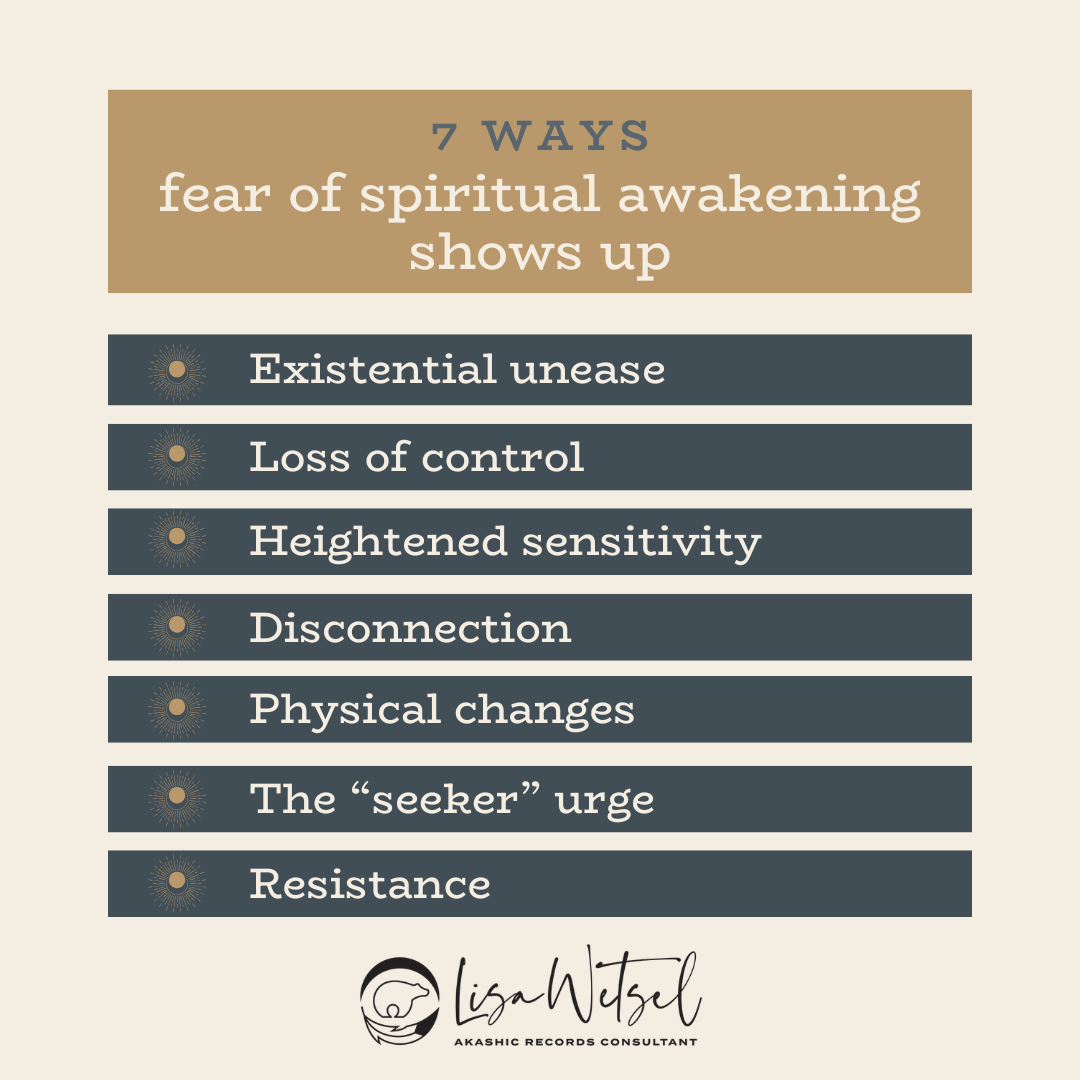
These experiences don’t necessarily mean something is wrong. In many cases, they reflect a system that’s adjusting to increased awareness and looking for steadiness as it does.
How to Navigate the Fear
When the fear feels overwhelming, the most helpful thing you can do is bring your attention out of the spinning mind and back into the physical body.
Spiritual awakening can feel like being pulled upward or outward; grounding is the practice of pulling your energy back down into the earth. If you feel like you are floating away or losing your grip, you don't need to "figure it out." You need to signal safety to your nervous system.
If you feel like you are floating away or losing your grip, try these simple practices:
Connect with Nature (Earthing)
Modern life separates us from the electromagnetic charge of the earth. You are a physical being for a reason. When the upper chakras open wide, we can lose our footing. Go outside. Stand on the grass, the dirt, or the sand.
Visualize roots growing from the soles of your feet deep into the crystalline core of the Earth. Ask Mother Earth to hold you. Ask her to take any excess energy or static you are carrying and transmute it.
Use Water to Reset
Water is the element of flow and emotion;salt is the element of protection and purification.
If you feel "porous", like you are picking up on everyone else’s emotions or fears, take a bath with sea salt or Epsom salts. Intend that the water is washing away any energy that is not yours to carry, sealing your energetic field and returning you to your own sovereignty.
Nourish the Body (Rooting Foods)
High-vibrational energy requires a strong container. While you may feel drawn to light foods, during times of intense fear or "wobble," your body needs density to anchor you.
Incorporate root vegetables - potatoes, beets, carrots - or leafy greens into your meals. These foods carry the frequency of the Earth. They help pull your energy down from the crown and settle it back into the root chakra, reminding your body that it is safe here.
Silence the External Noise
When the ego is afraid, it seeks answers outside of itself. It wants a guarantee. This leads to frantic researching and looking for someone else to explain your journey.
But the Akashic wisdom reminds us that you are the authority on your own soul. Step away from the books, the videos, and the theories.
Create a sacred pause. The answers you are looking for are not out there; they are encoded within you. Silence is the only place where you can hear them.
Return to Simple Routines
Engage in mundane, repetitive tasks like washing dishes by hand, folding laundry, or sweeping. These simple actions require presence and prove to your mind that you can still function in the 3D world.
It is a way of saying to the spirit: I am here, I am present, and I am tending to my life.
Fear as a Messenger, Not an Enemy
Fear often shows up at the edges of awakening, right where something new is trying to take shape.
It isn't there to stop you. It isn't there to warn you that you’ve done something wrong. It is simply there to let you know that something is shifting.
When awareness changes, fear can move through first. Almost like a pause. A tightening. A moment of wait. It’s part of the body noticing that what once felt familiar is starting to feel different.
There’s nothing you need to do with that.
Fear doesn’t always ask to be fixed or understood. Sometimes it just wants to be acknowledged. To be felt without being pushed away or pulled apart.
For some people, that happens naturally over time. For others, it helps to have a quiet container – something that lets fear unfold gently, without having to explain it or make sense of it right away.
If you feel drawn to that kind of space, I created a short email journey called From Fear to Freedom in 7 Steps. It’s there for anyone who wants to explore fear slowly, privately, and in their own rhythm.
Wherever you are in this process, fear isn’t a detour. It’s often just part of how awakening moves through a human life.


